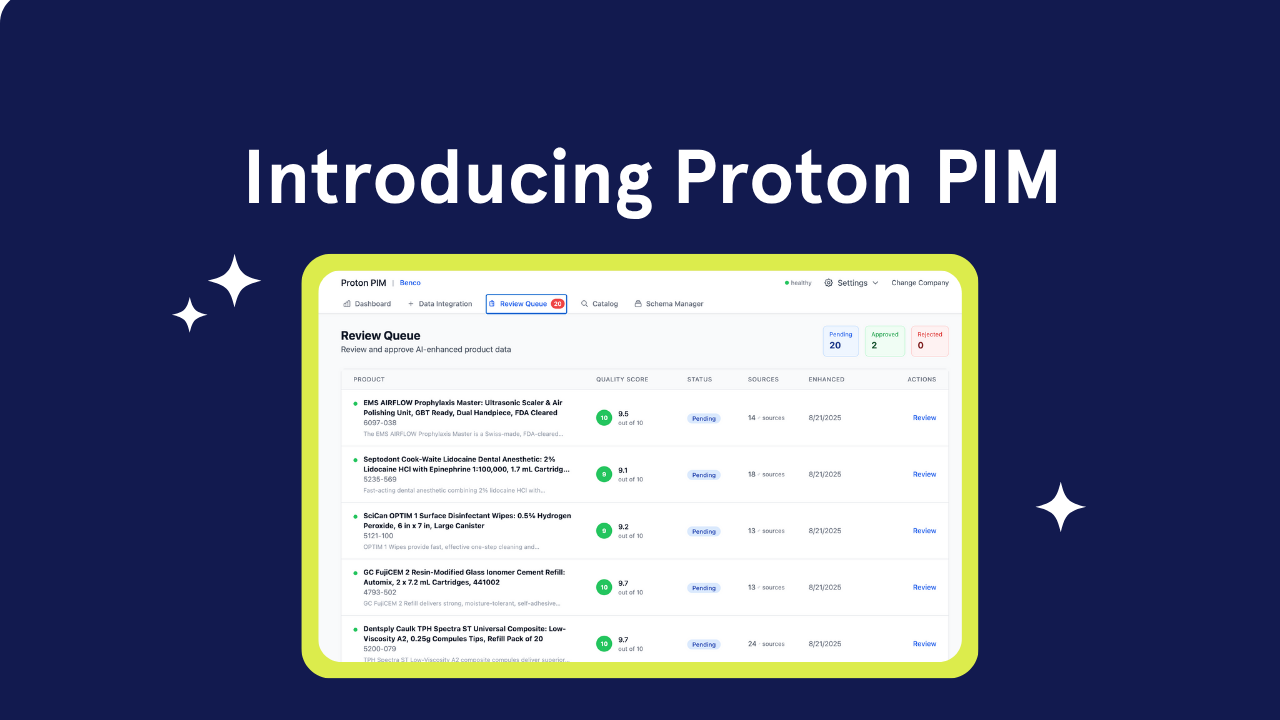
Most Product Information Management (PIM) systems were created to serve as digital filing cabinets: a place for teams to store data and hope it stays organized. But treating your PIM as just a place to store product information can actually end up costing you more in the long run.
Poor data quality costs organizations millions annually in lost revenue and operational waste, according to IBM's analysis of data quality impacts. For product data teams, the cost is people stuck manually fixing and filling in product data, which limits how many products they can list on their eCommerce site and how fast they can get them there. For distributors, that delay has a direct cost: every product that’s late to the site, or missing key details, is a sale that goes to a competitor instead.
The best PIMs do more than store your product data. They pull in information from multiple sources, clean it up, fill in the gaps, and send accurate product details to every channel where customers are ready to buy. For distributors and manufacturers juggling thousands (or millions) of products, that’s a big deal. The right PIM is the difference between products collecting dust in your warehouse and products flying off the shelf.
TL;DR
- Flexible data modeling that handles complex parent-child relationships without breaking your catalog.
- Automated ingestion and normalization that turns messy vendor data into a clean, searchable schema.
- AI enrichment that finds attributes and generates descriptions from raw specs, so you can say goodbye to manual data enrichment and entry.
- Clear data sources, so you can verify any information that needs a second look.
- Clear audit trails and governance workflows that log every change and enforce accountability.
Flexible data modeling and hierarchy management
The most fundamental constraint of any PIM is its data model. Lower-tier systems often force products into a flat list or rigid category tree, but real-world inventory requires more flexibility. An effective system should support complex relationships such as kits, bundles, assemblies, and multifaceted product families without breaking.
Your PIM should also give you the ability to define parent-child relationships where variants (like size or color) inherit common attributes from a parent product while maintaining their own unique SKUs. Inheritance drastically reduces data entry time. If you update the material description on a parent SKU, that change should cascade down to every color variant automatically.
AI-driven enrichment and content generation
Modern systems are moving away from manual tagging and toward AI in distribution. AI features in a PIM enable the tool to scan raw inputs like PDF spec sheets, vendor websites, or unstructured text descriptions, to automatically find and extract the attributes you’re looking for.
For example, if a supplier description reads "Heavy-duty steel hammer, 16oz head with rubber grip," the system should be able to parse that text to populate the "Material" field with "Steel," the "Weight" field with "16oz," and the "Handle Type" field with "Rubber." The best PIM tools will take it a step further and go out on the internet to gather information from manufacturers directly. This automated extraction shifts your team from data entry to high-value data validation.
This is important because the faster your products are live, the faster they can sell. By automating your data enrichment process, your team skips the manual sourcing and goes straight to reviewing AI-enriched specs, which ultimately cuts the time to list a new product on your e-commerce site.
AI also drives content scale by using generative models to rewrite technical specs into benefits-driven product descriptions suitable for e-commerce sites. These automated descriptions help your pages rank for SEO and convert visitors without requiring a copywriter to write descriptions for every SKU manually. This capability ensures that your catalog converts visitors without requiring a copywriter to touch every single functional SKU.
Automated data ingestion and normalization
Normalizing data across vendors is one of the hardest parts of product information management. One supplier writes "12 inches," another writes "12 in.," a third writes "1 ft." Your storefront filters break as a result.
Here's why: when a customer uses a filter on your site, your storefront does an exact match behind the scenes. A filter for "Length: 12 inches" only returns products tagged with that exact value. Anything tagged "12 in." or "1 ft." gets silently excluded, even though it's the same product.
A good PIM automatically identifies and resolves these inconsistencies on import, standardizing everything into a clean schema. That means the PIM finds duplicate specs like "12 inches," "12 in.," and "1 ft." and rewrites them so that they're all the same exact value, so every matching product shows up when a customer filters by that specific length. Without that normalization, it's nearly impossible for shoppers to find what they need, and that's lost revenue.
Integration capabilities
Your PIM can’t live in a silo. For it to deliver maximum value, it needs to sync with the other systems your team uses every day.
The most obvious integration is with your e-commerce platform. All that clean, enriched product data needs to flow directly to your website so customers can find and buy your products. But it shouldn’t stop there.
You also want your PIM synced with your CRM so your sales team has access to the same product info your web customers see. When reps can answer detailed product questions on the spot (things like specs, dimensions, or compatibility) they show up to every customer conversation sounding like product experts.
Integration also extends to your ERP. The PIM and ERP serve different purposes: your ERP owns pricing and inventory, while your PIM owns the product experience. But they need to stay in sync so your teams aren’t working from different versions of the truth.
Digital asset management (DAM) capabilities
Product data helps customers find an item, but product media gives them the confidence to buy it. A PIM with integrated DAM functionality keeps both in one place so no switching between systems, no broken links, and no mismatched versions.
But here's the problem most teams don't talk about: a DAM is only as valuable as what's inside it. Legacy DAM systems (and many modern ones) are essentially expensive, well-organized empty folders. Your team still has to hunt down images from supplier portals, chase down reps for updated spec sheets, and manually drag files in one by one. The storage is there. The assets aren't.
That's why a PIM worth investing in shouldn't just hold your digital assets, it should help you get them. Rather than waiting for files to land in the right place, the right system proactively gathers images, CAD drawings, and safety data sheets (SDS) and associates them directly to the product record.
Once assets are in, management should be effortless. Drag-and-drop association, automatic transformation, and channel-specific formatting mean the high-resolution image destined for your print catalog never ends up as an oversized mess on a mobile thumbnail. It also means that your sales team and customers always see the right version, in the right format, at the right time.
Data quality and trusted source workflows
When new product data enters your PIM, your team needs a quick way to see where it came from and know at a glance whether the source can be trusted.
That visibility is what keeps data moving. When data arrives from a vetted supplier or verified feed, your PIM should automatically approve it and push it back into your system, no manual review queue, no bottleneck. Good data from reliable sources shouldn't sit idle waiting for a sign-off that automation could handle.
The manual review process should be reserved for data that genuinely needs human judgment. Not everything.
Workflow management and collaboration
Data governance is a team sport involving product managers, marketers, SEO specialists, and legal compliance officers. A PIM system has to provide configurable workflows to manage the lifecycle of a record.
Changes to critical fields like pricing or safety warnings should trigger approval processes. If a junior associate updates a chemical description, the system should route that change to a compliance manager for review before it goes live. Workflow validation keeps unauthorized or erroneous changes from making it to your sales channels.
Collaboration features should also include granular field-level locking. You might want your ERP to own the "Price" and "Stock" fields (making them uneditable in the PIM), while your marketing team owns the "Description" field. Locking ensures that data overwrites do not occur when systems sync.
Audit trails and history logs
In regulated industries, tracing the source of a data point isn’t optional. Your PIM must maintain an immutable log of every change made to a record: who made it, when they made it, and what the previous value was.
These logs serve two primary purposes. First, they allow for root cause analysis if bad data reaches a customer. You can pinpoint exactly when an error was introduced. Second, it supports compliance audits where you must prove that safety data or origin claims have been managed according to standard operating procedures.
Regulatory pressure is expanding the scope of product data beyond marketing content. The EU Ecodesign for Sustainable Products Regulation (ESPR), which began applying in 2024, introduces the concept of a Digital Product Passport (DPP). This regulation will require companies to track and share data on materials, origins, and recyclability.
Multichannel syndication and API connectivity
The value of product data is zero until it is published. Syndication is the step that pushes your data to endpoints like your e-commerce site, Amazon, or customer procurement portals.
A PIM needs comprehensive API capabilities to push and pull data in real-time. Simply exporting a CSV file once a week is too slow for modern supply chains. The system should support channel-specific templates. Amazon requires different attributes than Shopify, which requires different attributes than a printed line card. Your PIM should map your core data to these external requirements so you don’t have to maintain separate spreadsheets for every channel.
Industrial and retail sectors increasingly rely on standardized data pools for synchronization. Features that support GS1 GDSN standards allow organizations to share interoperable product master data with trading partners globally. A PIM system should support these industry-standard data pools alongside direct API connections. Maintaining alignment with evolving standards, such as ECLASS or UNSPSC classifications, ensures that your product data remains compatible with the diverse procurement systems used by your largest customers.
Connectivity extends to the internal tech stack as well. The PIM must integrate directly with your CRM software to ensure sales reps view the same spec data as your web customers.
Security and access control
Product data often contains sensitive intellectual property and strategic pricing structures. Enterprise-grade security is non-negotiable. This includes Single Sign-On (SSO) for managing user access and Role-Based Access Control (RBAC).
You should be able to set permissions granularly enough that internally, only authorized personnel can export your full product list, mitigating the risk of data theft.
Conclusion
Distributors and manufacturers are learning that a traditional PIM doesn't solve bad data. It just gives you a cleaner place to store it.
The best systems today treat the "I" in PIM seriously. They use AI to clean, enrich, and repair data as it comes in, rather than leaving it to your team to fix manually.
That's what turns a PIM from a cost center into a growth lever. When you're evaluating options, prioritize systems that actively improve your data, not just ones that store it.
That's exactly what Proton is built to do. The platform uses AI agents to find and standardize product data for distributors, so your sales teams, web portals, and downstream channels are always working from accurate, complete information. To learn more about modern PIM systems, visit
FAQs about PIM system features
What is the difference between a PIM and an ERP?
An ERP (Enterprise Resource Planning) system manages transactional data like inventory levels, pricing, and financials, while a PIM manages commercial product data like descriptions, images, and marketing specs. The ERP is the source of truth for operations, while the PIM is the source of truth for the product experience.
Can a PIM system organize service-based products?
Yes, modern PIM systems can model intangible products like warranties, installation services, or service contracts. These are treated as non-stock SKUs but still profit from rich descriptions and relationships, such as linking a specific installation service to the machinery it belongs to.
How does AI improve PIM functionality?
AI improves PIM functionality by automating manual tasks like extracting specs, organizing your taxonomy, and writing product descriptions. It can also identify duplicate products or anomalies in data quality faster than humans.
Is a PIM necessary if we only sell on one channel?
Even with a single channel, a PIM provides value if you have a complex catalog or frequent data updates that are difficult to manage in a standard e-commerce backend. However, the ROI of a PIM increases significantly as you add more channels, suppliers, or product variants.
What security standards should I look for in a PIM?
You should look for SOC 2 Type II compliance, which ensures the vendor has rigorous controls for security, availability, and confidentiality. Additionally, features like Single Sign-On (SSO) and granular Role-Based Access Control (RBAC) are essential for maintaining internal security.

.png)