You've spent years building your product catalog. You carry thousands of SKUs, you've got strong vendor relationships, and your customers trust you to have what they need.
But when a customer goes to your website to search for a 3/4-inch brass ball valve, or a 12V cordless drill, or a specific grade of abrasive, can they actually find it? Can they see a photo, read the specs, and add it to their cart with 100% confidence?
For most distributors, the honest answer is: sometimes. And "sometimes" is costing you more than you realize.
The problem isn't your products. It's your product data. And the solution is a system called PIM, or Product Information Management.
Product information management tools, defined
PIM stands for Product Information Management. The term refers to both the practice of managing product data and the software category built to support it.
At its core, product information management is about collecting, organizing, enriching, and distributing product information across every channel your business uses: your eCommerce site, your sales team's tools, your print catalogs, and more.
PIM software is used by retailers, manufacturers, and B2B distributors. But distributors need a PIM the most. Because when you're managing tens of thousands of SKUs from hundreds of vendors, each sending data in a different format, at a different cadence, with different levels of completeness, you can't rely on spreadsheets and hope. You need a reliable, clear system.
Your single source of truth for product content
PIM software is a centralized platform where all of your product records live. It's different from your ERP, which handles pricing, inventory, and transactions. It's different from a DAM (Digital Asset Management system), which stores image files. A PIM is specifically designed to hold and manage your product content: descriptions, specifications, attributes, images, compatibility data, and everything else that tells a customer what a product is and why they should buy it.
Here's a useful analogy: Think of your ERP as the deed to a house, it’s the legal record of what exactly you own. Your PIM is more like the real estate listing: the photos, house description, and a list of all the features that make someone actually want to buy it.
A good PIM doesn’t just store specs, it actually finds and enriches your product information for you by scouring the web. It reads through manufacturer websites and product documents then consolidates it all into one authoritative source for your team.
Enrich and organize your entire product catalog
Modern PIM software handles the full lifecycle of product data:
- Centralization: Pulls product records from multiple sources into a single system of record
- Enrichment: Fills in missing specs, images, and descriptions
- Standardization: Normalizes inconsistent data (For example, reconciling duplicate field values like "Dark blue," "Navy," and "06-Blue" into one master value)
- Taxonomy management: Maintains the category hierarchy your catalog is organized by, so customers can easily find products via search on your eCommerce website.
- Syndication: Pushes clean, formatted product records to your eCommerce platform, ERP, CRM, and print catalogs so every sales channel has the most accurate, updated information.
- Workflow management: Routes new products and updates through an approval process before they go live on your eCommercite site.
Traditional PIM tools don’t do all of the above. Instead, they're essentially just digital containers. They give you a well-organized place to store product information, but they don’t actually help you *get* the data. That's still on your team.
Thankfully, modern AI-powered PIMs like Proton’s are different. Instead of waiting for someone to enter data manually, the AI actively finds missing information by scraping manufacturer websites, parsing PDF spec sheets, extracting attributes, and populating records automatically.
Why distributors need PIM more than anyone else
The case for PIM is sharpest in distribution, because of the scale and complexity of their product catalogs.
A typical distributor carries anywhere from 10,000 to 500,000+ SKUs across hundreds of vendors. Each vendor sends data differently. Some provide structured spreadsheets, others send PDFs, and many send nothing at all beyond a part number and a price. Your ERP wasn't designed to hold rich merchandising content. And your eCommerce site is only as good as the data powering it.
Poor product data makes it harder for your customers to find what they need, slowing your business growth. Here’s a few examples:
- A customer searches for "1/4 inch drill" but the product is cataloged as "0.25 in. drill" — search returns nothing, and they go to a competitor
- Filters on your website don't work because "Length" appears 47 different ways across vendor datasets. When each vendor calls it something different, your search won’t work properly.
- Product pages have no images, no specs, no descriptions, so they rank poorly in search engines and your buyer can’t find any of the listings. Instead, they end up buying on Amazon or ordering from a competitor.
- Sales reps stop trusting the catalog after finding one wrong spec and go back to Googling everything themselves. This takes up way more of their time, resulting in fewer sales.
This is what makes a PIM so important for distributors: a product information management tool gives your entire team a single, reliable source of truth for product data. As a result, it makes products findable, buyable, and recommendable across every channel.
PIM and ERP: Two systems built for two very different jobs
This is one of the most common questions distributors ask, usually when they're trying to justify a new system to someone who thinks the ERP already does the job.
It doesn't. Here's why:

Your ERP is the operational backbone of your business and should stay that way. But using it as a product content system means accepting its limitations: 30-character description fields, no image support, rigid structures that weren't designed for merchandising. That's why distributors who rely on ERP data alone end up with eCommerce sites that look broken and catalogs that reps don't trust.
On the other hand, a PIM works alongside your ERP, instead of replacing it. It takes the SKUs your ERP knows about and turns them into fully fleshed-out product records that are ready to sell.
How most distributors try to solve the product data problem (and why it doesn't work)
Before PIM, distributors cobbled together solutions from whatever was available. Most of these workarounds are still common today, but they all hit the same wall eventually.
Solution #1: Chasing manufacturers for data
The most direct approach seems obvious: ask your vendors for product specs. Email the manufacturer, request a data sheet, enter it into your system.
But in practice, this is slow, inconsistent, and doesn't scale. Many manufacturers are unresponsive, especially for older or lower-volume SKUs. Distributors frequently get ghosted entirely, or receive a PDF that needs to be manually transcribed field by field. Multiply that across hundreds of vendors and tens of thousands of SKUs and you have a team spending most of their time chasing data instead of using it.
To make matters worse, this has a strong ripple effect. When it takes weeks or months to gather specs for a new product line, you can't get those products live on your eCommerce site quickly. This inability to onboard new products fast is a direct cap on your online revenue since customers searching for those items won’t find you.
Solution #2: Offshore data entry agencies
When the backlog gets bad enough, many distributors hire offshore agencies to handle data enrichment at scale, paying teams abroad to manually research and enter specs for thousands of SKUs.
Sounds fine in theory, but the execution is harder than it looks.
First, it's slow. Turnaround from an offshore team takes weeks or months, during which new products keep arriving and the backlog keeps growing.
Second, accuracy often suffers, especially for technical industrial products. One distributor we worked with hired an offshore agency to enrich data for their mortar product line. The agency, unfamiliar with the construction materials industry, enriched the records as if "mortar" referred to artillery munitions — instead of the building material used to set bricks and tile. The entire batch had to be discarded and redone.
That's not a knock on offshore teams. It's a reflection of the core challenge: enriching product data accurately requires deep domain knowledge. That knowledge is hard to transfer, and the cost of errors compounds fast at scale.
Option 3: Buying group catalog data
Many distributors belong to buying groups, cooperative purchasing organizations that negotiate on behalf of their members. Some offer a compelling-sounding benefit: pre-enriched product data you can license and load directly into your catalog.
It sounds like a great shortcut, but it creates two new problems.
First, the data goes stale. Buying group product data is updated on a fixed schedule: quarterly or annually in most cases. In the meantime, vendor specs change, products get discontinued, new items arrive. By the time the next update comes, a meaningful chunk of your catalog is already out of date.
Secondly, and most importantly, it's identical for every member. Every distributor in the buying group who licenses the same data gets the same descriptions, the same attributes, the same copy word for word. In other words, you're competing against your own buying group peers, with the same content, for the same keywords. From an SEO standpoint, this is a serious problem. Google deprioritizes duplicate content. A product page that's identical to dozens of other distributor sites won't rank.
Distributors who rely on buying group data often discover this the hard way: the eCommerce site launches, the catalog looks complete, and organic traffic never materializes because every product page is a copy of someone else's.
The 2 problems every PIM must solve: enrichment and taxonomy
When distributors evaluate PIM software, they tend to focus on the interface, the integrations, and the price. But the most important question is whether the system actually solves the two core product data problems facing distributors, since many traditional PIMs address neither.
Problem 1: Data enrichment
Data enrichment is the process of filling in what's missing. A SKU arrives in your system with a part number and a short description. By enriching it, you find the missing specs, images, dimensions, the compatibility notes. Everything a customer or a sales rep needs to understand and buy the product.
Most traditional PIMs give you a place to *store* enriched data, but they don't help you actually *get* it. That's still entirely on your team: chasing manufacturers, parsing PDFs, hiring agencies to do the work. The PIM is the container; but you're still responsible for filling it.
An AI-powered enrichment engine like Proton’s PIM changes this. Instead of waiting for your team to manually source every spec, the AI scours manufacturer websites, parses technical documents, and extracts attributes automatically. The PIM doesn't just hold the data — it goes and finds it, then actually organizes it for you. Which leads us to problem #2….
Problem 2: Taxonomy
Taxonomy is the structure of how you organize your product catalog: the category hierarchy, the attribute names, the values that make products filterable, comparable, and findable. Without a well-designed taxonomy, even a fully enriched catalog fails because products are impossible to find.
Here's what bad taxonomy looks like in practice. Say your catalog has 300 types of flashlights. Over years of data entry from different people and vendors, those flashlights have accumulated attributes named "runtime," "Run Time," "Battery Life (hrs)," "Hours of Use," and a dozen other variations — all meaning the same thing. Your website filter for "runtime" returns a fraction of the relevant products. Customers can't compare options. Search breaks.
Taxonomy management means defining a master standard and normalizing your entire catalog against it. This is painstaking work to do manually at scale.
Traditional PIMs let you define your own standards, then leave the normalization entirely to you. An AI-powered system like Proton’s PIM identifies duplicate and overlapping attributes automatically, suggests consolidations, and applies normalization rules across your catalog without requiring your team to do it by hand.
Why most PIMs only do half the job
The uncomfortable truth about the PIM market is that most tools are built around storage and governance, not around actually solving the true data problems distributors actually face. They're designed for organizations that already have good, structured data and just need a safe place to keep it.
But distributors rarely have complete, cleanly-structured data. In reality, we’re often juggling thousands of vendor PDFs, ERP exports with 30-character limits, a stack of spreadsheets managed by someone who left two years ago, and an unruly taxonomy that’s grown over the years.
A PIM that can't help you enrich your data and normalize your taxonomy isn't solving your problem. It's giving you a more organized place to store your mess.
Traditional PIM vs. AI-powered PIM
This is the most important distinction in the modern PIM market.
Traditional PIMs (Akeneo, Salsify, InRiver, Pimcore) are databases. Well-organized, well-connected databases, but databases. They give you a place to store product information and tools to manage it.
What they don't do is get you the data. That's still a human problem, which means the "empty box" problem persists. You buy the software, configure it, and then realize you still need a team to populate it.
AI-powered PIMs like Proton change the fundamental model. Instead of waiting for humans to enter data, the AI actively goes and gets it by:
- Scraping the web. The AI reads manufacturer websites and extracts specs without anyone lifting a finger
- Parsing PDFs. Spec sheets, installation guides, and catalogs are parsed and converted into structured attributes
- Normalizing attributes. The AI recognizes that "Navy," "00-Blue," and "Dark Blue" all map to the same master value.
- Confidence scoring. Every AI suggestion comes with a confidence level, so your team knows where to focus their review time.
Getting a traditional PIM to "full" requires months or years of manual effort. An AI-powered PIM can show meaningful enrichment in days and handles new vendor lines and ongoing catalog maintenance automatically, rather than creating a perpetual backlog of work.
How PIM software works: step-by-step
1. Ingest raw data: upload your existing ERP export, a messy vendor CSV, or connect via API
2. AI enrichment: the system uses AI to read through manufacturer websites and parses spec sheets to fill missing attributes
3. Attribute normalization: AI flags inconsistent field names to standardize your taxonomy across all your vendors.
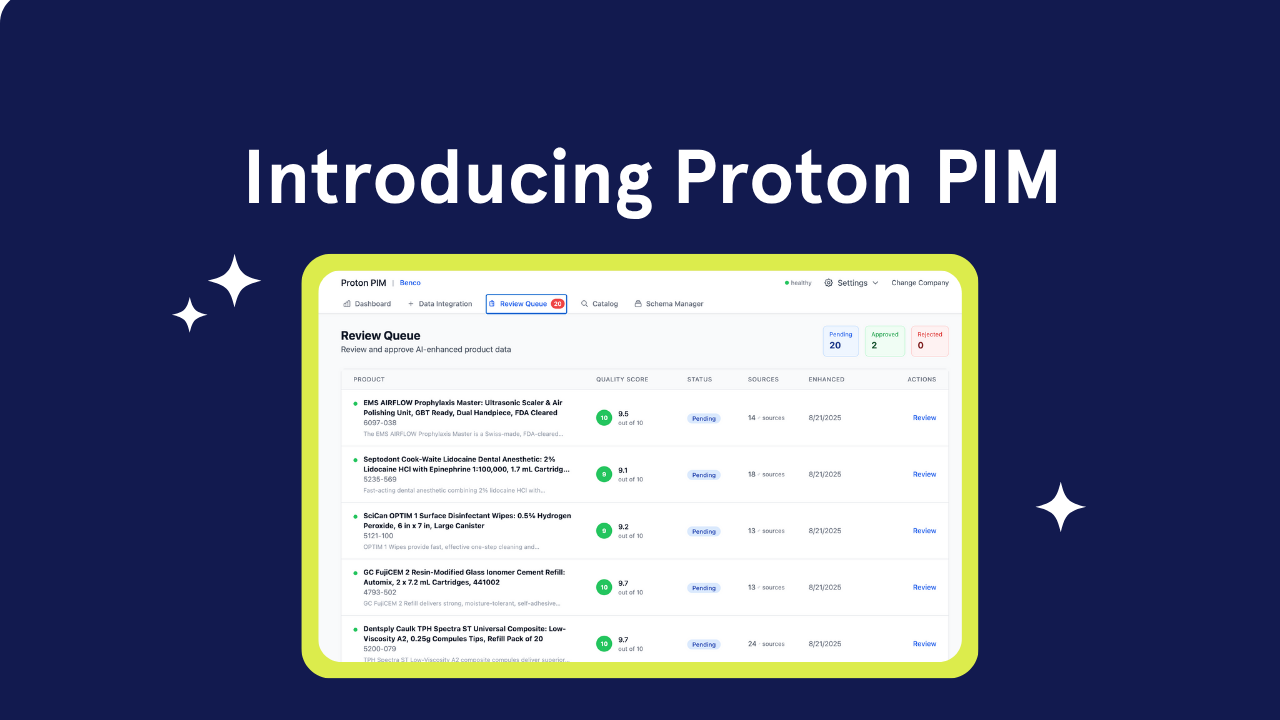
4. Review queue: your team approves or rejects AI suggestions.
5. Golden record creation: once approved, you have a clean, complete product record.
6. Syndication: that new product record is then pushed to your eCommerce platform, your CRM, and any other connected systems.
Signs you need PIM software
Your team is likely in need of a product information management (PIM) software if:
- You have 10,000+ SKUs with incomplete or inconsistent data
- Your eCommerce site search returns poor results or customers complain of frequent "no results found" errors on your website
- Your team spends significant time manually sourcing or cleaning data from vendor PDFs and emails
- You're launching or relaunching an eCommerce site
- Your buying group data is identical to your competitors' and your SEO rankings show it
- You want to increase your eCommerce conversion rate
- Your sales reps complain that they don’t have enough product information to sound like true experts when talking with customers.
If you're a distributor with fewer than 1,000 SKUs and no digital sales channel, a spreadsheet may still be sufficient as an internal PIM. But for the vast majority of distributors with serious eCommerce goals, the question isn't whether you need a PIM. It's which one.
Here’s a blog that covers exactly what to look for in a PIM for distributors. When evaluating your options, remember to look for a tool that offers:
- AI-powered enrichment
- Integrations for your eCommerce tool, your ERP and CRM
- Set-up in weeks (not months)
- Unstructured data handling
Frequently asked questions about PIM
What does PIM stand for?
PIM stands for Product Information Management. It refers to both the practice of managing product data and the software category built to support it. In practice, PIM covers everything involved in collecting, organizing, enriching, and distributing product information across every channel your business uses: your eCommerce site, your sales team's tools, your print catalogs, and more. For distributors managing thousands of SKUs from dozens of vendors, it's the foundation that makes your product data usable.
What is PIM software?
PIM software is a centralized platform where all of your product records live. Unlike your ERP, which handles pricing, inventory, and transactions, or a DAM, which stores raw image files, a PIM is purpose-built to manage product content: descriptions, specifications, attributes, images, compatibility data, and everything else a customer or sales rep needs to understand and buy a product. Think of your ERP as the deed to a house, the legal record of ownership. Your PIM is the real estate listing: the photos, the description, and all the details that make someone want to buy it.
What does PIM software do?
PIM software helps teams enrich and organize all of their product data so it can be used consistently across every selling channel. That means pulling product records from multiple sources into one system, filling in missing specs and images, standardizing inconsistent data from different vendors, maintaining your catalog's category hierarchy, and pushing clean, complete records to your eCommerce platform, ERP, CRM, and print catalogs. The result is a single source of truth for your product content so every customer, sales rep, and channel always sees accurate, up-to-date information. Modern AI-powered PIMs go a step further by actively sourcing missing data from manufacturer websites and spec sheets, rather than waiting for your team to enter it manually.
Why do distributors need a PIM?
Distributors face a product data problem that's bigger and more complex than almost any other business type. A typical distributor manages tens of thousands of SKUs across hundreds of vendors, each sending data in different formats, at different cadences, with wildly different levels of completeness. Your ERP wasn't built to hold rich merchandising content. Your eCommerce site is only as good as the data powering it. And without a reliable system, customers can't find your products, sales reps can't trust your catalog, and your search rankings suffer. A PIM gives your entire organization one authoritative source of product truth: making your catalog findable, buyable, and recommendable at scale.
What's the difference between PIM and an ERP?
An ERP handles the operational side of your business: pricing, inventory, orders, and financials. A PIM handles product content: descriptions, specs, images, attributes, and everything that makes a product ready to sell. Your ERP is designed for transactions; a PIM is designed for merchandising. ERPs typically have rigid, character-limited fields and little to no image support. They were never built to power an eCommerce experience. A PIM works alongside your ERP rather than replacing it: your ERP tracks what you own, and your PIM turns those records into fully enriched product pages your customers can actually use.
The bottom line
Product information management is the infrastructure that makes your products findable, buyable, and recommendable. Without it, you're leaving money on the table every day in the form of search failures, sales reps who can’t sell your catalog, and SEO that never shows up.
The traditional workarounds like chasing manufacturers, using offshore agencies, or relying on buying group data all have the same fundamental flaw: they require enormous effort to produce results that are still incomplete, often inaccurate, and guaranteed to fall behind. And most PIM software doesn't actually fix this. It just gives you a better-organized container for your mess.
Remember, a PIM worth buying solves both problems: it enriches your data *and* normalizes your taxonomy, automatically, at scale and it does so without requiring an army of people to make it work.
Proton PIM was built specifically for B2B distributors. Not retailers, not manufacturers, not generic enterprise customers, but just for distributors. It handles the complexity of all your product data, ERP constraints, and multi-vendor chaos that traditional PIM tools weren't designed for.
Ready to see what your product data looks like when the AI does the heavy lifting? Sign up to try Proton PIM for 30 days.




.png)