
Testing your way to better CAC, conversion, and industry turns | Kevin Weadick
In this episode, Kevin Weadick, President and CEO of TricorBraun, shares how he settled the oldest argument in distribution marketing: does any of it actually help the branches and the reps?
In this episode, Benj sits down with Kevin Weadick, President aad CEO at TricorBraun, whose career runs through Grainger, Zoro, FleetPride, and more.
Kevin shares how he settled the oldest argument in distribution marketing: does any of it actually help the branches and the reps? At FleetPride he ran geo-paired market tests, shutting marketing off in one market and leaving it on in a matched one, then watched what happened to local sales. What he found gave the team the confidence to spend a lot more aggressively.
He also gets into why centralizing inventory and pricing has less to do with whether corporate can do it better and more to do with which branch manager you pick for your first pilot. If you're trying to figure out what your marketing is really doing for your sellers, where to do market tests, or how much autonomy to leave with your branches, this one's worth your time.
Benj: I'm Benj, founder and CEO of Proton AI, the AI-powered CRM built specifically for distributors. You're listening to In the Mind of a Distributor, where we interview the smartest minds in distribution. Let's get into it.
Benj: Kevin, thanks so much for joining In the Mind of a Distributor. Kevin Weadick was at Grainger, then at Zoro, then at FleetPride, and now at TricorBraun. Lots and lots of distribution experience. We got connected, I think, when you were still at Zoro. Thanks so much for coming on the podcast.
Kevin: Thanks for having me, Benj. Looking forward to it.
From accounting to supply chain
Benj: To get started, it'd be great to hear how you first got into distribution. How did you end up at Grainger? Did you wake up as a kid dreaming of selling industrial products, or what was the journey?
Kevin: No, I did not. I joined an accounting firm right out of undergrad and did that for five years, then decided I did not want to be an accountant. My largest client had been 3M, and I had gotten to learn a lot about 3M and their supply chains. Obviously they're more of a manufacturer. But I decided I was going to go back to grad school, get re-credentialed, and focus on supply chain.
As I was graduating and thinking about where to go work, I asked myself: where is supply chain actually going to be strategically important to the business? And a distributor is basically supply chain. So I said, all right, I'm going to go work at Grainger, because they're a leading distributor, they're really innovative in the space, and they're going to put me in a position where the thing I'm passionate about is core and central to the strategic execution of the business.
Benj: So when you came into Grainger, you were focused on supply chain. And you were there for 20 years.
Kevin: Almost 21 years, and that includes Zoro, because Zoro is part of Grainger as a holding subsidiary.
How Zoro became a platform
Kevin: Zoro was born out of Grainger. There were a couple of people who came over from Japan and were part of the original seven-person team that started Zoro. I was not one of those folks. I came in after the business had grown up a bit, and I was probably the second leader of the business after the person who led it through its early days.
Zoro started out more as a separate brand leveraging Grainger's supply chain, and to some extent Grainger's existing supply relationships. It would be, hey, 3M, you have 80,000 items in your portfolio and Grainger only merchandises 10,000. Zoro wants to merchandise all the others. Can you drop ship them?
When I got there, we pivoted. We said there's probably a group of distributors that aren't as strong at e-commerce as we are, and we might be able to do for them what Zoro does for Grainger, which is reach small businesses. We might be able to form partnerships with those distributors, take their assortment, merchandise it, and have them fulfill on our behalf.
So the thing that became really different about Zoro versus, say, MonotaRO, was that Zoro was a platform. MonotaRO was a traditional distributor with a really, really heavy e-commerce focus.
Making distributed fulfillment work
Benj: There are all kinds of challenges that come with the marketplace model. It shows up in someone else's box. How do returns work? How did you sort through those things once you broke off from just shipping Grainger's products under a new name?
Kevin: Part of it was that there were certain things we asked for. We had a playbook for getting a distributor live, and part of that playbook was: we're going to need you to ship in a brown box, and we're going to help you format a shipping label and a packing slip that has limited branding on it, so it doesn't refer to that distributor's brand, it refers to Zoro's brand. All the communications the customer gets are going to point them back to Zoro.
So you're going to handle fulfillment. We're actually going to give you the freight contracts to ship on. We're going to make it super simple for you. You just need to ship, and you need to give us certain information back when you ship so we can pass it to the customer, like the tracking number.
If the customer has any issues, they return to us. Depending on who we partnered with, we negotiated different types of return arrangements. We generally had a fairly low return rate, so returns didn't end up being a huge issue. And then we just needed to be really thoughtful about the right pricing.
That part of the business was super high return on invested capital because we had no assets. We were basically coordinating between a distributor and the customer, and we sat in the middle of all that. We would also protect the distributor's anonymity, because distributors might not want anyone to know they were shipping on Zoro. That could create channel conflict for them. So what we said was, if you're selling us a product by brand X or brand Y, that's what we'll list as the supplier on the website. We'd merchandise it as the brand and not say where we were actually sourcing it from.
It worked pretty well. When I joined, maybe 1% of sales was not off Grainger's supply chain. When I left, it was a much, much higher percentage. So it really helped the business model scale.
There would also be times when we delisted suppliers, because even though we had their assortment, they couldn't deliver in a way that was meaningful for the customer. They couldn't do what they said they were going to do. Maybe their execution in their core business was fine and they deprioritized us, whatever it was, but their execution didn't allow us to create the right brand perception for Zoro. We wanted to make sure we were giving a great experience.
What I'd say is you can add more items to your assortment, but you have to be able to credibly serve against that, and it has to tie to your customer's needs at some level. So Zoro tended to look at how we expand assortment in the categories we thought were big areas of interest for our customer base.
When a marketplace model damages your brand
Benj: So pricing is quite different from a traditional distributor, and you have to think through that. And the execution of a marketplace is just different from shipping your own stuff. If you're not good at that skill, it's not going to work, because the customer experience will fall apart.
Kevin: You need to be able to create the business processes that let you orchestrate that distributed commerce. If you can't do that, you're probably going to damage your brand, because you're not going to serve the customer very well.
You do see partnerships out in distribution where distributors in really different market segments partner and extend their assortment to each other. Those are absolutely helpful. But there's an agreement between those parties that they're going to fulfill against a service level agreement, and if they can meet that service level agreement, it can work really well.
Zoro has a slightly simpler challenge than a true marketplace, because Zoro has marketplace-scale assortment but it's more of a buy-sell relationship with specific distributors. You can't just list on Zoro.
Benj: It's more curated.
Kevin: It's invite only. By invite, I mean two parties agreeing to do business with each other, as opposed to someone signing up and trying to come up in the search feed.
What FleetPride is
Benj: This is probably a good transition to your experience at FleetPride. The pushback someone might give is: it's easy to say all marketing is really finance when you don't have a sales team. You put an ad on Google Ads and you figure it out. But how does that model translate to a world where you have branches, where you have boots on the ground going out and calling on customers? The CAC math is way more complicated when human beings are involved.
Kevin: It is, but you can still understand it. When I was at FleetPride, one of the things we did was start doing more digital marketing than we had done.
Benj: Wait, before you jump into this, can you give the five-second version of what FleetPride is for those who don't know?
Kevin: FleetPride is America's largest heavy-duty truck parts provider serving the aftermarket. Think semis, dump trucks, buses, all those kinds of things. When something on them breaks, FleetPride, through its network of 300-plus branches, is there to get you the parts you need.
It's really different from Grainger in some ways and very similar in others. It's different in that the products tend to be really heavy, so the branch network is super important for fulfillment, and a lot of the fulfillment is done on our own delivery rather than through common carrier. There's also a lot of walk-in traffic to the branches. Those are big elements of FleetPride's value proposition. It's very similar to Grainger in that you go to market with a sales force, with branches, with e-commerce, and with long-tail distribution. Selling things customers don't hold in inventory and didn't know they needed until they needed it.
Proving marketing's value with geo-paired tests
Benj: So going back to the finance point, how did you bring that lesson over into an environment where you had e-commerce but also branches and reps and the whole thing?
Kevin: For us it was really about making sure the team could go on a journey of learning. What we wanted to understand was: what's the value of the marketing, aside from the value of just having the seller or just having the branch?
To do that, you go back to an older-school test. The way people would tell if billboards were working was a match market test. You'd create market pairs, run billboards in one and no billboards in the other, and see how those market pairs evolved over time.
We did something very similar at FleetPride. We were confident in the digital results we were getting. What we didn't know was what halo all that digital marketing might have on our salespeople and our branches. So we did geo pairing. We took markets of material size to our business, paired them up, and our first test was to turn marketing off in one and leave it on in the other, then see what happens. What we were able to do then, with a high degree of confidence, was say that the digital marketing was highly accretive to the local branch and sellers.
Think of it as the website, and the marketing halo we generated off of it, becoming the salesperson's right hand when they couldn't be there. It was a way to make sure FleetPride was always in the consideration set and staying top of mind. A lot of people would use their phones to order, or they'd use their phone, see an ad, know that FleetPride had the product, go to our website, and check if it was in stock. They might not place the order online. They might call. They might drive in.
But what we saw was that the marketing we were doing generated a tremendous halo into the branch and for the sellers. It allowed us to have the confidence to scale our ambitions and be more aggressive.
A quick word from our sponsor: Most sales reps spend 72% of their week on admin tasks instead of actually selling. Proton changes that. We're a CRM built for distributors that guides your reps on who to call and what to sell. Our AI assistant Pronto even gives instant answers to questions like, "What do I need to know about this account?" or "Which product should I pitch them next?" Swish nearly tripled their growth rate by using Proton. You could too. Start by visiting proton.ai to learn more. Now back to the show.
Test, then scale the spend
Benj: The common marketing adage is, I know half my marketing doesn't work, I just don't know which half. You were actually testing which marketing activities were working and then scaling those activities.
Kevin: Yes. And then you'd ask, well, what if I spent more? So you can test for scaling up your spend.
That's a pattern that has existed for a lot of years. It's the same as a coupon code in an email. You confer a discount to someone, they buy, and they enter that code. That's what catalogs did years and years ago, before the advent of any e-commerce. They wanted to know how effective that marketing vehicle was, so they created a custom code for it.
Earning the right to centralize
Benj: That playbook makes sense on the marketing side. One other question on FleetPride. Zoro obviously has no salespeople and is 100% centralized. Grainger has branches but a fairly centralized model in terms of the sales process and the tools. There are some distributors on the far end of that spectrum where basically every branch gets to decide what they want to do. How did you think about that at FleetPride, and how did it change over time as you were investing in digital capabilities that were platform-wide?
Kevin: Ignore the digital piece for a second and think about supply chain management and the branches. Historically, branches defined their own inventory: this is what I'm going to stock, this is mine. You see a lot of that in more traditional distribution, where the local branch has a lot of autonomy in determining what they buy and what they hold.
What we tried to do was understand that there's so much signal available, and you can use that signal to inform decision-making and think about how you deploy inventory to drive customer experience and customer expectations. While I was at FleetPride we did some work to really lean in and think about how we help the branch. How do we build more trust so that the branch allows us to create a little more centralization? How do we use all the signal we have from inquiries, sales orders, and quotes to think about what the inventory footprint should look like in that local market, and then help the branches build trust that we have a team capable of delivering against it?
Local relationships are super important. Whether it's through a branch or a local sales force, there are still a ton of people in distribution where the customer buys because of the relationship they have with their sales team. That's largely because their sales team is the face of the broader organization, and the person who, if something goes wrong, they know will make it right. There's huge importance in relationship-driven selling. Where the central team can help is: how do we back you up, and how do we help you be really effective at maintaining and sustaining those relationships?
Change management is the actual problem
Benj: Did you actually see an improvement in profitability from centralizing some of those functions? That's always the tension. People say the branch has better data about what's happening in that particular market, so we don't want to centralize it. And they don't trust corporate to do it right.
Kevin: Test, learn, scale. You go find a few people who are willing to evaluate the decision-making you're doing.
I remember we were piloting some of the inventory work we had done, and we went to one of the branches that was probably the most skeptical. We asked the leader to be part of the pilot and commit to certain behaviors. The feedback was: I looked at the top 500 items you were recommending, and I only disagreed with two, so you guys are doing pretty good work.
A lot of that is just about change management. It's not actually about whether you can do it better or not. You could centralize some things and destroy value, and you can centralize some things and create a lot of value. The important part is having the right feedback loops and building trust.
For us at FleetPride, whether it was on pricing or inventory strategy or whatever it was, we needed to go build trust with the local teams. So you get a group of folks from those local teams to be very engaged in the pilot, to give you great feedback, and to tell you when you're not being as successful as it looks like you think you're going to be on paper. Then you learn. And then they become your change agents, your advocates. You take the people who have a lot of organizational trust from their peers, because their peers know.
The other thing is, if you help them be really successful, they're going to tend to make more money, because their incentive structures reward them for it. That's a really great way to build trust with someone: do the kind of work that impacts their paycheck and lets them earn more for themselves and their local teams.
So it's part do the right thing, and part make sure you do a great job communicating it. I think most initiatives fail because of a lack of communication.
Benj: Especially if they're value-creative initiatives like what you're describing.
Kevin: And if you're asking people to change, no one likes change. People say they do, they don't. It is the rare person who actually wants to do something differently. So you need to show them that something is better, and you need to help them really learn to see the difference and why it's better.
If you do that in a way that's respectful of the heritage of the business and the things they've been great at, and you're just there to help them be even more successful, and you manage the change well and scale it in a way that lets the organization keep up, then good things will happen.
A very different business at TricorBraun
Benj: Pivoting to TricorBraun, the company you're at now, which is a new adventure for you. Give us the quick preview on TricorBraun, and then I'd love to hear about ramping up into another business that's actually pretty different from FleetPride and different from Grainger.
Kevin: That was part of the excitement about joining. I knew the previous leader, Cork, from my time at Grainger. He was retiring and had reached out. I wasn't really thinking about making a move, but as I learned more and more about it, I thought, wow, this is really different, this is an amazing business.
TricorBraun is the largest North American rigid packaging distributor and one of the world's largest rigid packaging distributors. What is that? It's all the kinds of stuff you see behind me. We're across a variety of substrates, from glass to aluminum to plastic, and also flexible packaging. It's a global business, with operations in North America, Europe, and Australia and New Zealand. So it's a broader scope and scale business from a geographic footprint than FleetPride was.
FleetPride and Grainger were both what I'd describe as long tail. You'd sell someone a widget, then two days later a different widget, then two days later a different widget. That's not this. We have some customers buying millions of bottles or millions of closures from us. We have other customers buying tens of thousands.
The way I think about it is we help brands scale. When we're at our best, we're the partner for your brand, helping you get it to market. We do have an e-commerce presence, but that's more around brand awareness. Really, the way we create value is through a direct sales force that's out scouring the market every day, trying to understand which up-and-coming brands we can help navigate from those early days all the way to being in every supermarket across the country.
The digital lessons he's bringing over
Benj: What are the big digital lessons you're bringing to the business? You described the test-and-learn concept, thinking about marketing through a finance lens.
Kevin: A lot of what we're focused on is creating data-driven insights that help our team be more successful. I've only been here five months, so we're still working through it. We've had some really productive conversations with our board about where we want to go.
A lot of what we've talked to our team members about comes down to the fact that it's kind of bumpy out there right now. A lot of our brands are consumer product companies, and the consumer is under stress. So we've talked a lot about how we stay resilient, where we think there are opportunities for them to grow, and how we think about both share of wallet and net new name accounts. In the coming months we'll have a pretty big conversation with our team about what we've learned as an executive team and where we're going. We're right in the throes of that work now, which has been fun for the team.
Right now our number one mantra is to be in front of customers, listening to the challenges they're going through, whether they're tariff-related or demand-related, both brands that are scaling and brands that are shrinking. How do we help them be successful in serving their customers? Because that's how we'll be successful.
Benj: Which goes back to where we started, you talking about why it didn't matter that you didn't grow up in sales. The answer is because you care about the customer, and that's the same approach here.
What he's still curious about: generative AI
Benj: We love to end on the same question. We value curiosity at Proton, it's one of our core values. So what's one thing you still don't have a good answer for, or are still trying to figure out in distribution, even after such a long career?
Kevin: I think it's everything, seriously. I love that your value is curiosity, because that's one of the most important things any team member can have, being curious and always thinking about how we can do this better.
One area we're really curious about is generative AI. How can we use that? We have all this information trapped in disparate systems. Is there a way to bring that information together and give it to our team members so we can help them be more effective in serving the customer? I'm super curious about that right now, because I do think it's going to be transformative. I just don't think everybody knows exactly how yet.
I love curiosity because I'm pretty sure the team at Zoro is doing things way better than they were when I was there. And I'm pretty sure the team at FleetPride will have great success. As a leader, what you want to do is build a team that gets really curious about how to serve the customer better and constantly challenges itself. How can we do this in a way where we're more efficient, so we have more time to support the customer in ways that are impactful for them? Or how can we do this differently in a way that lets us take share, because we'll distinguish ourselves in the value we create?
Benj: It strikes me that the test-and-learn mindset you described is an environment where curiosity can really thrive. You've got an idea, try it out, see if it works.
Kevin: At Zoro we modeled a concept that MonotaRO had around A/B testing in e-commerce. They were very thoughtful about the fact that even if the test is no better than the control, as long as it's not worse, they're going to ship it. By doing it, you encourage team members to think, oh, I can see my work come to life, and I'm going to continue to be curious because they're taking my ideas and bringing them forward.
People want to make good differences in their business. You want to empower them to make those choices, and then you want to think about how you nurture that curiosity. It was a cool way to think about creating really positive feedback loops with team members so they always want to bring new ideas to the table.
Benj: Love that. Kevin, thank you so much for coming on. Really appreciate it.
Kevin: That was awesome, Benj. I appreciate you having me.
Benj: That's it for this episode of In the Mind of a Distributor. If you liked this conversation, leave a review, it helps more folks in distribution find the show. If you're thinking about a CRM for your business, head to proton.ai to see how Proton can help you grow faster. Or if you want to connect with me, you can add me, Benj Cohen, on LinkedIn. Thanks for listening, and I'll catch you next time.
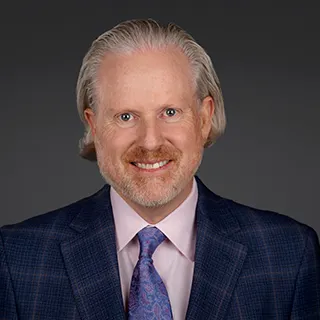
Kevin Weadick
President and CEO, TricorBraun
Kevin is the CEO and President of TricorBraun, a global packaging leader and a portfolio company of Ares Management and Ontario Teachers’ Pension Plan. He previously served as CEO of FleetPride, America’s largest independent heavy-duty parts distributor. Prior to FleetPride, Kevin held several leadership roles at Grainger, including a six-year tenure as President of Zoro.com. Kevin holds both a BBA and an MBA from the University of Wisconsin. He currently serves on the Boards of the University of Wisconsin Grainger Center for Supply Chain Management and the NAW Institute.
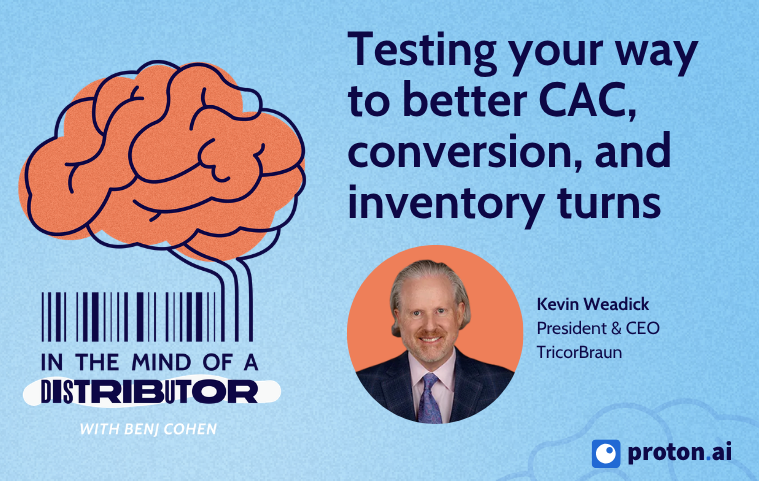
Testing your way to better CAC, conversion, and industry turns | Kevin Weadick
Four lessns from Kevin Weadick, Tricor's President and CEO, on how to test your way to better CAC in distribution.
Never miss an episode
Lessons from the front lines of distribution—one honest conversation at a time

%202.svg)
%201.svg)
%20(1).png)
%20(1).png)
.png)