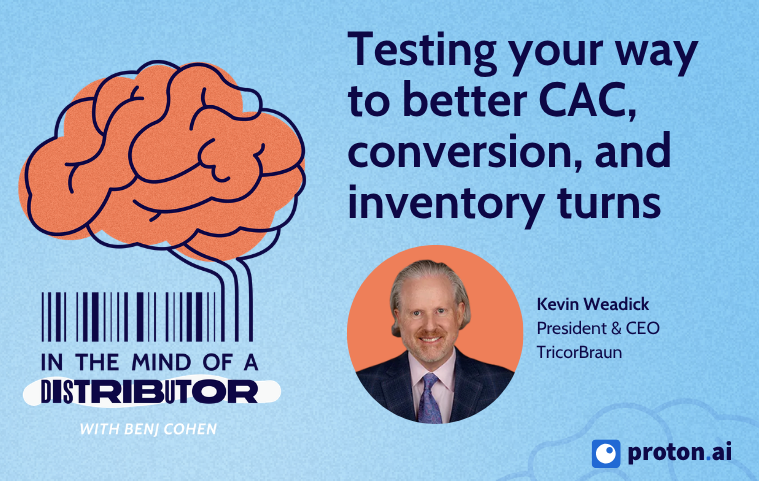
Kevin Weadick spent almost 21 years at Grainger, including a run leading Zoro through its shift from a Grainger side brand into a platform business. From there he went to FleetPride, America's largest heavy-duty truck parts distributor with more than 300 branches, and five months ago he joined TricorBraun as its digital and supply chain leader. He started his career as an accountant, decided he didn't want to be one, and went back to school for supply chain because a distributor, in his words, is basically supply chain.
In his appearance on the In the Mind of a Distributor podcast, Kevin walked through how he proved that digital marketing was actually helping FleetPride's branches and sellers, why centralizing inventory is a trust problem more than an analytics problem, and what he's carrying into a business that sells millions of bottles at a time instead of one widget at a time.
Below are four lessons any distributor can take from the conversation.
Lesson 1: Prove your marketing works the way billboard buyers used to
The hardest question in distribution marketing is whether any of it helps the field. You can attribute an e-commerce order. You cannot easily attribute the customer who saw an ad, checked stock on their phone, and then called their rep.
Kevin's answer was to borrow a much older method. "The way people would tell if billboards were working is they would actually do a match market test. So you'd create market pairs and you would do billboards in one and no billboards in the other, and then you would see how those market pairs evolved over time."
At FleetPride, he ran the same design with digital. "We were confident in what digital results we were getting. What we didn't know is what halo all that digital marketing might have on our salespeople and our branches. And so we did geo pairing."
They took markets of material size to the business, paired them up, turned marketing off in one and left it on in the other, and watched. The result was that they could say "with a high degree of confidence" that the digital marketing was "highly accretive to the local branch and sellers."
The framing Kevin used for what that actually meant is worth stealing for your next internal conversation about digital spend. The website and the marketing halo around it "just became the salesperson's right hand when they couldn't be there. It was just a way to make sure that FleetPride would always be in the consideration set and staying top of mind." Customers would see an ad on their phone, know FleetPride carried the part, check stock on the site, and then call or drive in. "They might not place the order online. They might call. They might drive in. But what we saw was that the marketing we were doing generated a tremendous halo into the branch and for the sellers."
That reframe matters internally. Digital investment stops being a threat to the field team and starts being coverage for the accounts they can't get to this week.
Lesson 2: A clean read is what lets you spend more
The point of testing isn't a slide for the board. It's permission to scale.
Once FleetPride knew the halo effect was real, the conversation changed. "It allowed us to have confidence to scale our ambitions and be more aggressive," Kevin said. And then the next test writes itself: "Well, what if I spent more? And so then you can test for scaling up your spend."
He's quick to note none of this is new. "It's the same as a coupon code in an email. That was what catalogs did years and years ago, before the advent of any e-commerce. They wanted to know how effective that marketing vehicle was, so they created a custom code for it."
Most distribution marketing budgets are set by last year's budget plus or minus a percentage. A budget set by test results is a budget you can defend and grow.
Lesson 3: Don't add assortment you can't credibly serve
At Zoro, Kevin's team built a platform where partner distributors fulfilled orders under Zoro's brand, in brown boxes, on Zoro's freight contracts, with the partner's identity protected to avoid channel conflict. When he joined, roughly 1% of sales came from outside Grainger's supply chain. When he left it was a much higher share.
But they also delisted suppliers. "Even though we had their assortment, they just couldn't deliver in a way that was meaningful for the customer. They couldn't do what they said they were going to do." Maybe execution in the partner's core business was fine and Zoro got deprioritized. Either way, it damaged how Zoro's brand felt to a customer.
His rule: "You can add more items to your assortment, but you have to be able to credibly serve against that. And it has to actually tie at some level to your customer needs."
The warning is blunter for anyone eyeing a dropship or partner-fulfillment program without the operational work behind it. "You're probably going to damage your brand, because you're not going to actually serve the customer very well."
Lesson 4: Centralizing inventory is a change management problem
Branch autonomy over stocking decisions is one of the oldest tensions in distribution. Corporate says it has better signal. The branch says it knows its market. Nobody moves.
Kevin's take is that the analytics are usually the easy part. "It's not actually about whether you can do it better or not. You could centralize some things and destroy value, and you can centralize some things and create a lot of value. The important part is to have the right feedback loops and then to build trust."
His approach at FleetPride was to test, learn, and scale with the least likely volunteer. "We went to one of the branches that was probably the most skeptical, and we asked the leader to be a part of the pilot." The feedback came back better than expected: "I looked at the top 500 items that you were recommending, and I only disagreed with two. So you guys are doing pretty good work."
Two things make that work. Pick pilots with peer credibility, because skeptics who convert become your advocates. And make sure the people in the pilot come out ahead financially. "That's a really great way to build trust with someone, is to do the kind of work that impacts their paycheck and allows them to actually earn more money for themselves and their local teams."
The failure mode isn't the model. It's the rollout. "I think most initiatives fail because of a lack of communication," Kevin said, and he has no illusions about how people receive change. "No one likes change. People say they do, they don't. It is the rare person that actually wants to do something differently. So you need to show them that something is better. And you need to help them really learn to see the difference and why it's better." Tone is part of it too, doing the work "in a way that's really respectful of the heritage of the business and the things that they've been great at."
One more idea from Zoro fits here. Zoro modeled MonotaRO's approach to A/B testing, where a test that performs no better than the control still ships as long as it isn't worse. The logic is cultural rather than statistical. "By doing it, it encourages team members to be like, oh, I can see my work come to life. And I'm going to continue to be curious because they're taking my ideas and bringing them forward." If you want a test-and-learn culture, people have to see their ideas go live.
One thing Kevin is still trying to figure out
When Benj asked what he's still curious about, Kevin went to generative AI, and specifically to the problem every distributor recognizes.
"We have all this information that's trapped in disparate systems. And is there a way to think about how we can bring that information together and give it to our team members so that we can help them be more effective in serving the customer? I'm super curious about that right now, just because I do think it's going to be transformative. I just don't think everybody knows exactly how yet."
The broader answer was about the trait itself. "As a leader, what you want to do is build a team that gets really curious about how you serve the customer better and just constantly challenges itself." He also pointed out that he assumes the teams at Zoro and FleetPride are running things better now than when he was there, which is a fairly rare thing for an executive to say out loud.
FAQ
What is a geo-paired market test?
It's a version of the match market test that billboard advertisers used before digital attribution existed. You pair markets that are similar in size and business mix, run marketing in one and pause it in the other, then compare how the pair performs over time. The gap between them is your read on incremental impact, including impact that never shows up as an online order.
How do you measure whether digital marketing helps a field sales team?
Attribution models won't get you there, because much of the impact ends in a phone call or a walk-in rather than a click. A geo-paired holdout test measures total market performance instead of tracked conversions, which captures the halo effect on branches and reps. At FleetPride, that test showed digital was highly accretive to local selling.
Should branches control their own stocking decisions?
There's no universal answer, but Kevin's view is that the central team usually has more signal available from quotes, inquiries, and orders than any single branch does. The obstacle is trust, not math. Running a pilot with a skeptical, well-respected branch leader and making sure the pilot improves their results is how you earn the right to centralize.
What made Zoro different from a marketplace?
Zoro carried marketplace-scale assortment but operated as a buy-sell relationship with specific, invited distributors rather than an open listing platform. Partners fulfilled orders under Zoro's branding and had their identity protected to avoid channel conflict, and Zoro removed partners who couldn't hold up service levels.
Who is Kevin Weadick?
Kevin Weadick leads digital and supply chain at TricorBraun, the largest rigid packaging distributor in North America. He previously spent almost 21 years at Grainger, including leading Zoro, and then served at FleetPride, America's largest heavy-duty truck parts distributor serving the aftermarket.

%20(1).png)

%20(1).png)
.png)