Most distributors don't have a software problem. They have a "none of it talks to each other" problem.
Your order history lives in the ERP. Your reps' notes live in their heads, or their phones. Quotes go out from five different inboxes in five different formats. And when a customer quietly stops reordering a category they used to buy every month, nobody notices until the quarter closes.
Distribution management software is supposed to fix that. The trouble is the term is slippery: to some vendors it means a full ERP, to others a lighter tool that bolts onto one. This guide cuts through it — what it actually is, how to choose, and an honest look at the platforms worth your shortlist in 2026, including where our own product, Proton, fits and where it doesn't.
TL;DR
- "Distribution management software" is an umbrella term. Decide first whether you need a system of record (ERP/DMS), a system of action (CRM), or both.
- The hardest part isn't picking software — it's getting your team to use it. Adoption, not features, is where most rollouts die.
- Full-suite platforms worth evaluating: NetSuite, Acumatica, Microsoft Dynamics 365 Business Central, SAP S/4HANA, Epicor (Prophet 21, Eclipse, BisTrack), Infor (CloudSuite Distribution, SX.e), Sage, and SYSPRO.
- If your ERP already works but your reps are flying blind, you don't need to rip it out. You add an AI platform across the top.
What is distribution management software?
Distribution management software — sometimes called wholesale distribution software, or just distribution software — is the system distributors use to run the business: purchasing, inventory, order management, pricing, fulfillment, and the customer relationships behind it. For most distributors the core of that is a distribution-focused ERP, often called a distribution management system (DMS), the single system of record for what's in stock, what shipped, and what was invoiced.
There's one distinction worth holding onto. Your system of record tells you what happened. It doesn't tell your reps what to do next, which customer is slipping, which quote went cold, where the next order is hiding. That's a different job, and it's where an AI industry cloud like Proton comes in, sitting across the ERP and the rest of your stack to put that data to work. This guide covers both: the systems that run distribution, and the AI platform that acts on their data.
The six problems the right system actually solves
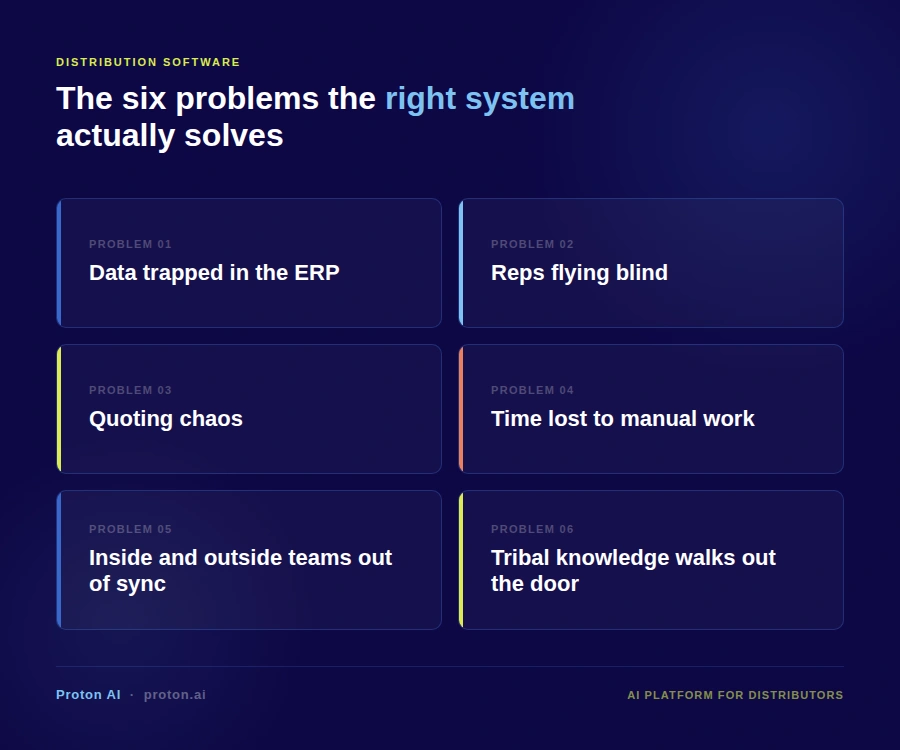
Feature lists blur together. The reason to buy is the problem you're solving. Across hundreds of conversations with distributors, the same six keep coming up:
- Data trapped in the ERP. The most valuable data you own: order history, margins, and buying patterns, sits in a system your reps can't easily see or act on. Often it's spread across several ERPs after acquisitions, with no real-time bridge between them.
- Reps flying blind. Little visibility into what happens before a quote, where revenue is leaking, or which accounts are churning or quietly dropping a category. That blind spot costs real money.
- Quoting chaos. Every rep quotes differently: some formal, some over email, some by phoning the office. Quotes get lost; follow-up is inconsistent.
- Time lost to manual work. Outside reps can lose an hour or two a day just logging into systems and digging through reports to figure out what to do. Time not spent selling.
- Inside and outside teams out of sync. Outside reps can't see what inside sales is working on, so customers get redundant or missed follow-ups.
- Tribal knowledge that walks out the door. "The customers who buy argon should also be buying wire" lives in a veteran rep's head. When they retire, it leaves with them, and new reps start from zero.
If a demo can't show you how it kills at least three of these, it's a feature tour, not a solution.
How to choose distribution management software
Most of the decision comes down to a handful of universal questions, they apply whether you're buying a full system of record or a tool that sits on top of one:
- Built for distribution. Reorders, multi-location inventory, contract pricing, thousands of SKUs, not a horizontal tool you have to bend into shape.
- Clean data flow. Your ERP holds the most important data, so anything you run has to sync with it in near-real time, or it becomes one more silo. Ask exactly how that integration works: native, API, or middleware.
- Implementation and adoption support. Weigh this heavily, the best software your team won't use loses to the mediocre tool they will. Ask who actually runs the implementation: the vendor, or a third party.
- Total cost, and a vendor that will last. Licenses are just the start; budget for implementation, integration, and training, and vet the partner as carefully as the product.
Beyond those, what you scrutinize depends on what you're buying. For a system of record (a DMS/ERP), go deep on inventory, purchasing, order management, pricing, fulfillment, financials, and multi-location support. For an AI platform like Proton, the industry cloud across your stack, the test is different: does it turn ERP data into action — surfacing the cold quote, the under-buying customer, the account going quiet — without a rep building a report, and will reps actually use it day to day?
The best distribution management software in 2026
A note on how this list is grouped. Most of it is full-suite distribution ERP/DMS platforms, your system of record. Proton is the outlier: it's the AI industry cloud that sits across your whole stack. We've included ourselves because distributors ask us where we fit, and we'd rather say it plainly than pretend we replace your ERP. We don't.
Full-suite distribution ERP / DMS platforms
Epicor (Prophet 21, Eclipse, BisTrack)
- Best for: distributors who want software built for their exact vertical. Epicor is one of the few vendors with ERPs designed specifically for distribution, Prophet 21 for general wholesale, Eclipse for electrical/plumbing/HVAC, BisTrack for building materials. That focus shows.
- Watch-outs: some interfaces feel dated, though modernization is ongoing.
Infor (CloudSuite Distribution, SX.e)
- Best for: mid-to-large distributors wanting industry-specific cloud ERP. Infor's distribution suites are purpose-built for wholesale, with strong industry functionality.
- Watch-outs: as with most enterprise suites, implementation quality varies by partner.
NetSuite
- Best for: multi-entity distributors who want one cloud system for everything. Oracle NetSuite is the default cloud ERP for mid-market and up: inventory, order management, fulfillment, financials, and multi-currency in one place. Strong if you're consolidating entities or regions.
- Watch-outs: implementation is a project, not a weekend, and costs climb with modules and users.
Acumatica
- Best for: growing distributors who want the whole warehouse in the system. Acumatica's distribution edition covers purchasing, inventory, order fulfillment, and warehouse management with solid mobile support. Its consumption-based pricing — you pay for resources, not per user — is genuinely distributor-friendly when your entire floor needs access.
- Watch-outs: you'll usually buy and implement through a VAR partner; vet them as carefully as the software.
Microsoft Dynamics 365 Business Central
- Best for: small-to-mid distributors already living in Microsoft. Inventory, purchasing, orders, warehouse, and financials in one cloud platform, with Copilot AI built in and natural ties to Microsoft 365.
- Watch-outs: distribution depth often comes from ISV add-ons. Budget for them.
SAP S/4HANA
- Best for: large, complex, global distributors. Deep supply-chain and logistics capability at enterprise scale.
- Watch-outs: cost and complexity are real, and it's overkill for most regional distributors.
Sage (X3, 100)
- Best for: distributors with manufacturing or compliance-heavy product lines. Sage X3 handles multi-site, multi-currency operations and shines where traceability and compliance matter, such as food and beverage, chemicals, industrial goods. Sage 100 serves smaller operations.
- Watch-outs: the range is broad; make sure you're sold the right product.
SYSPRO
- Best for: distributors who also manufacture. SYSPRO is an ERP with deep roots in manufacturing and distribution, strong on inventory and traceability.
- Watch-outs: a smaller partner-and-app ecosystem than the megavendors.
Fishbowl
- Best for: smaller distributors who run on QuickBooks. Not a full ERP, Fishbowl is entry-level distribution inventory software with tight QuickBooks integration, barcoding, and multi-location tracking. A pragmatic step up from spreadsheets.
- Watch-outs: you'll outgrow it as complexity rises.
How they stack up
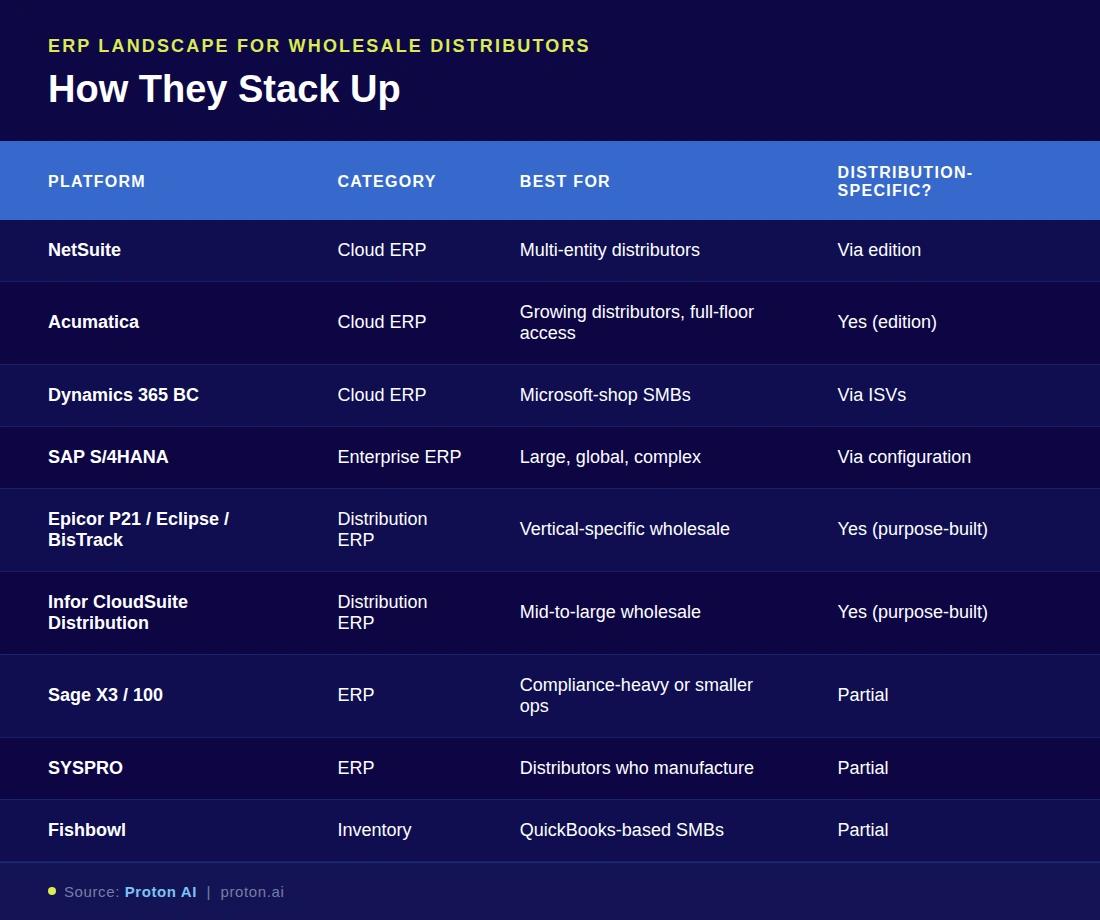
Don't skip this: why most distribution software fails
Any of these platforms can technically do the job. They tend to fail for one of two reasons, and which one bites you depends on what you're putting in.
A system of record — a DMS or ERP — usually fails structurally. It doesn't integrate cleanly, the data feeding it is messy, the rollout is under-resourced, or the software gets bent to fit a process it was never built for. Those are project and integration problems, and they're avoidable with scope discipline and a vendor who implements the software themselves rather than handing you to a third party who has no idea what was promised.
Anything your reps touch directly, like a CRM or sales layer, fails on adoption instead. It doesn't matter how good the tool is if the team won't use it. The rollouts that stick share a few traits: leadership clearly explains the why, the launch is phased with real training rather than flipped on all at once, and everyone expects the most tenured reps to resist changing how they work. Plan for that; don't act surprised by it.
Either way, weight implementation and support near the top of your criteria, not the bottom. For more, see our guide to successful software implementation in distribution.
The bottom line
Start from the problem, not the product. If you don't have a reliable system of record, choose a distribution ERP from the list above and weight implementation support as heavily as features. If you already have one and your reps still can't see or act on the data inside it, you don't need to rip anything out — you need an AI platform that unifies your data and acts on it. Either way, the platform that wins is the one your team will actually use.
Want to see what an AI industry cloud looks like across your stack? Book a Proton demo. Or, if you're earlier in the search, start with how to select the best CRM for distributors.





.png)